DOCTOR OF PHILOSOPHY IN
ISLAMIC THOUGHT AND CIVILISATION

PROGRAMME OVERVIEW

The aim of the Doctor of Philosophy in Islamic Thought and Civilisation (Research) programme is to produce graduates with advanced, comprehensive and integrated knowledge, and who are highly critical, with skills and attitudes suited to becoming researchers, teachers, and practitioners in Islamic Thought and Civilisational studies within both local and international contexts.

ENTRY REQUIREMENTS

  • A relevant Master’s degree with good grades from IIUM or any other accredited institution of higher learning; or
  • Any other accredited institution of higher learning; or
  • Any other appropriate qualifications that are recognized as equivalent to a Master’s degree by the Senate of IIUM; and
  • Proficient in English Language (IELTS 6.0 or TOEFL 570) or the IIUM administered English Placement Test (EPT).

    Prospective students without sufficient academic background in their chosen field of study may be required to audit or complete prerequisite courses relevant to their thesis research, as determined by the selection committee

PROGRAMME DETAILS

Study Duration
Full-time Part-time
Long Short Long Short
No. of Weeks – – – –
No. of Semesters 6 4 10 6
No. of Years 3 5
Programme Structure
Subject Classification Credit % MQA
Compulsory Courses 0 – –
Core / Major / Concentration
• Courses / Modules
0 0% 0%
Research 40 100% 100%
Others (specify) – – –
Total Credit Value 40 100% 100%

COURSES

Research Methods
IITC 8001
This course introduces students to the science and art of research in the social sciences and humanities. It examines the nature and limits of research from Western and Islamic perspectives. The course will focus on various aspects of research: methods of research, stating a problem, literature review, framework for analysis, methods of data collection, locating materials, textual criticism, proposal writing, and referencing/documentation.
div class="istac-course" style="margin-bottom: 35px;">
Islamic Revivalism: Problems and Prospects
IITC 8025
This course focuses on the principal reform and revival movements in the Arab World, Turkey, Iran, South and South-east Asia. The subject is studied in the wider context of the tradition of revival and reform rooted in the teachings of the Qur’an and the Prophet (saw), encompassing different times and forms across the Muslim world from West Africa to Central Asia.
div class="istac-course" style="margin-bottom: 35px;">
Islam in Malay History and Culture
IITC 8007
This course introduces the understanding of the Malay world as part of the Muslim world at large, through the study of the manifestation of Islam in the various cultures and histories of nations and civilisations in the region. It examines the advent and spread of Islam in the Malay world and its impact on socio-economic, political, and educational institutions, highlighting key reformist movements and figures.

CAREER PATHWAYS

Academia and Research
Engagement in teaching, advanced research, and scholarly publication within universities, research institutes, and intellectual centres of Islamic thought and civilisation.
Policy and Strategic Advisory
Contribution to policy development, governance, and advisory roles in governmental and institutional bodies concerned with religion, culture, and societal development.
Religious and Community Leadership
Leadership in religious institutions, community organisations, and educational initiatives that shape ethical, intellectual, and social development.
Publishing and Intellectual Discourse
Authorship, editorial work, and public intellectual engagement through books, journals, and media addressing contemporary and classical Islamic thought.
Education and Curriculum Development
Design and development of academic and educational programmes that integrate Islamic knowledge with contemporary disciplines.
International and Civilisational Engagement
Roles in international organisations, NGOs, and cultural institutions contributing to intercivilisational dialogue and global knowledge exchange.
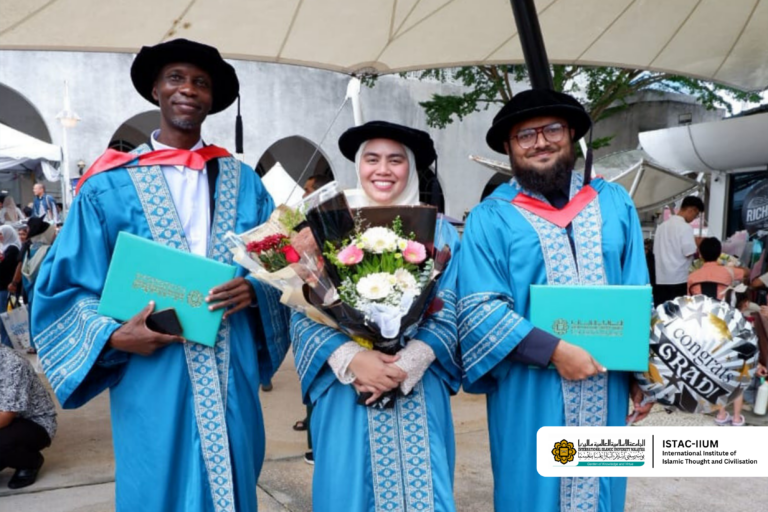
ISTAC PhD Graduates, IIUM 41st Convocation Ceremony (2025)